Safe & secure JunoCash wallet
Take control of your JunoCash assets with complete confidence in the Trezor ecosystem.
- Secured by your hardware wallet
- Use with compatible hot wallets
- Trusted by over 2 million customers
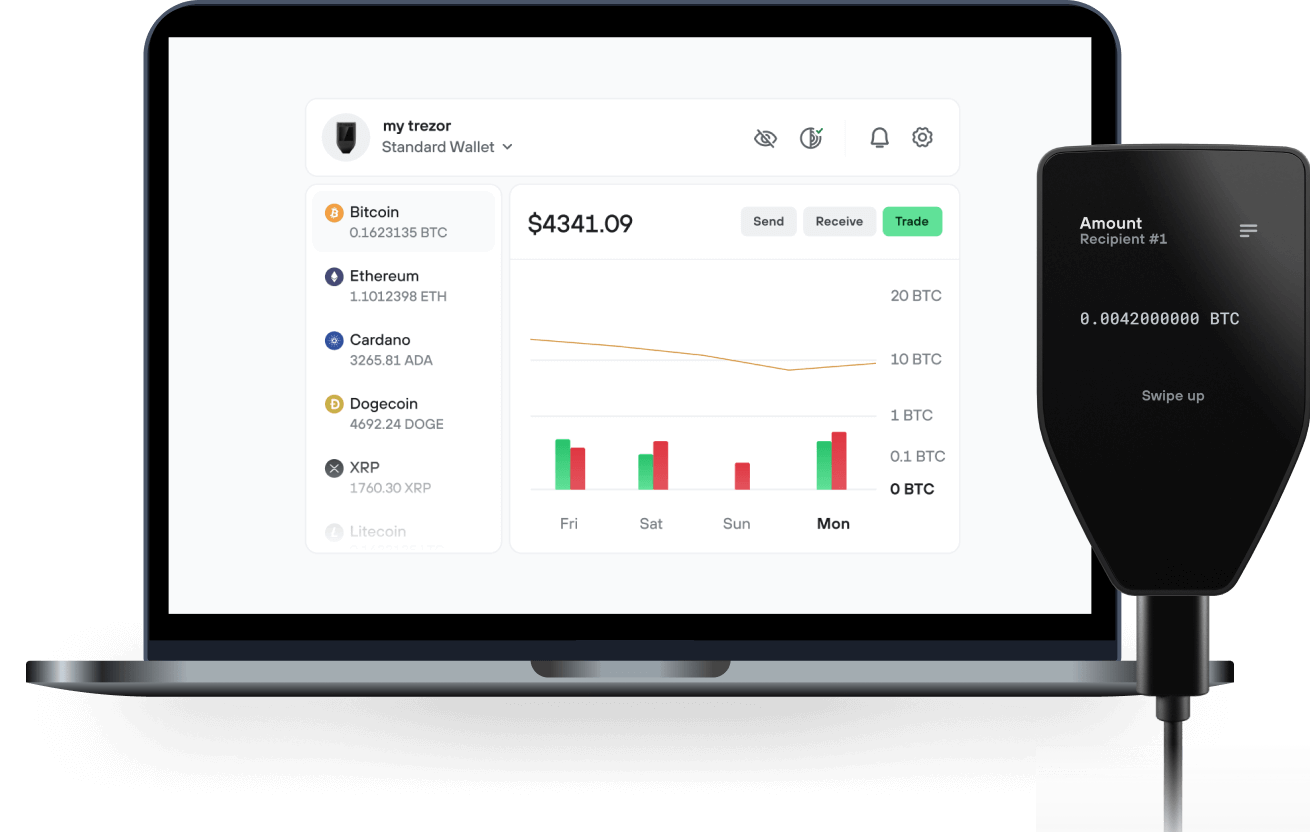
Send & receive your JunoCash with the Trezor Suite app

Send & receive
Trezor hardware wallets that support JunoCash
Sync your Trezor with wallet apps
Manage your JunoCash with your Trezor hardware wallet synced with several wallet apps.
Trezor Suite
MetaMask
Rabby
Supported JunoCash Network
Why a hardware wallet?
Go offline with Trezor
- You own 100% of your coins
- Your wallet is 100% safe offline
- Your data is 100% anonymous
- Your coins aren’t tied to any company
Online exchanges
- If an exchange fails, you lose your coins
- Exchanges are targets for hackers
- Your personal data may be exposed
- You don’t truly own your coins
How to JUNO on Trezor
Connect your Trezor
Open a third-party wallet app
Manage your assets
Make the most of your JUNO
Trezor keeps your JUNO secure
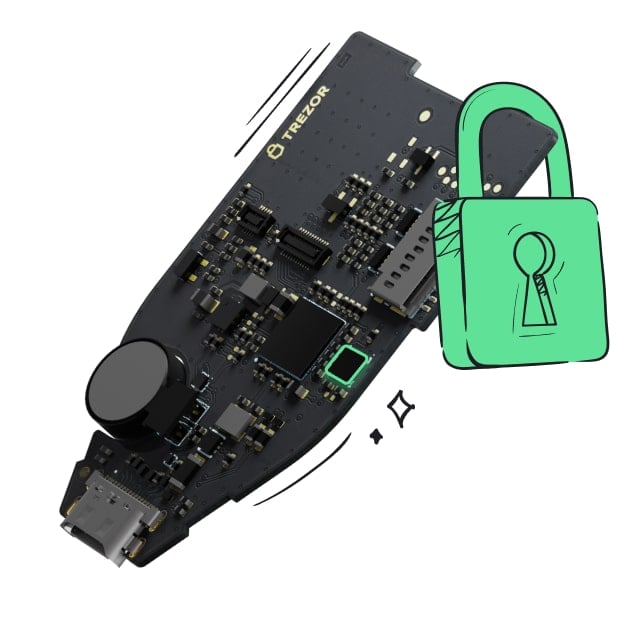 Protected by Secure Element
The best defense against both online and offline threats
 Your tokens, your control
Absolute control of every transaction with on-device confirmation
 Security starts with open-source
Transparent wallet design makes your Trezor better and safer
 Clear & simple wallet backup
Recover access to your digital assets with a new backup standard
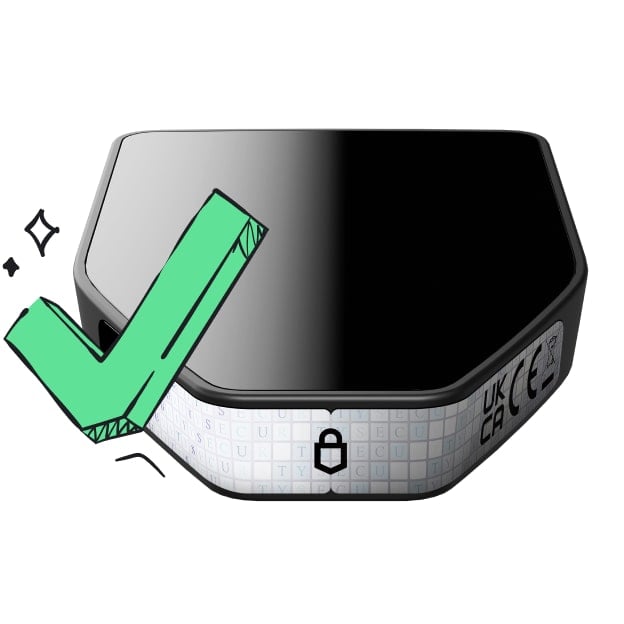 Confidence from day one
Packaging & device security seals protect your Trezor’s integrity
Launched on 15/11/2025, Junocash (JUNO) is a privacy-focused, proof-of-work cryptocurrency with a fixed supply of 21 million coins, in which 100% of circulating coins are permanently shielded using zero-knowledge proofs. The protocol enforces mandatory privacy for all transactions: senders, receivers, and amounts are encrypted on-chain, with only transaction fees publicly visible. There are no transparent transactions, no optional privacy toggles, and no exceptions.
Bitcoin established a robust monetary framework, including fixed supply, proof-of-work consensus, and a predictable halving schedule, but its fully transparent ledger creates fungibility and privacy problems. When every transaction is publicly traceable, individual coins can be flagged, blacklisted, or valued differently based on their history. This breaks fungibility, a property essential to sound money. Bitcoin's SHA-256 mining is also dominated by specialized ASIC hardware, concentrating block production among industrial-scale operations. Juno Cash retains Bitcoin's core monetary properties, including a 21 million coin hard cap, 4 year halving cycle, and proof-of-work security, while addressing these shortcomings through mandatory privacy and CPU-accessible mining.
Junocash uses the Orchard shielded transaction protocol with Halo 2 zero-knowledge proofs, which require no trusted setup ceremony. This eliminates the cryptographic trust assumptions present in earlier zero-knowledge systems. Transaction signing completes in 2-5 seconds on commodity hardware, with verification under 100 milliseconds. New coins are minted openly for simple supply auditability, but must permanently enter the shielded pool before they can be spent, with no way to leave once inside. Because all transactions are shielded by default, no transaction graph exists, and there are no visible links between senders and receivers to analyze. Every coin is indistinguishable from every other, and the anonymity set is 100% of all transactions on the network. This restores the fungibility that transparent blockchains lack.
Users who need to share transaction details for compliance, auditing, or personal record-keeping can do so selectively through view keys, without compromising privacy for the rest of the network.
Mining on JunoCash uses the RandomX proof-of-work algorithm, which is designed to run efficiently on general-purpose CPUs and resist optimization by ASICs and GPUs. This enables anyone with standard consumer hardware to participate in block production and coin issuance, rather than requiring the specialized equipment that dominates Bitcoin mining. The network targets 60-second block intervals with a 100-block difficulty adjustment window, reducing block time variance and improving confirmation predictability. Mined coins require 1,000 block confirmations before they can be spent, providing additional security suited to a CPU-mined network.
JunoCash launched with no premine, no initial coin offering, no founders' rewards, and no developer tax. 100% of all block rewards go to miners. The project is open-source under the MIT license, with cross-platform node software available for Linux, Windows, and macOS (Intel and Apple Silicon). Mobile and desktop wallets, a standalone RandomX miner (junorig), mining pool infrastructure, and block explorer are available alongside the core node software.
The whitepaper, source code, and additional resources are available at https://juno.cash.