Sichere & geschützte General Impressions Wallet
Übernimm die Kontrolle über deine General Impressions Assets mit vollem Vertrauen in das Trezor Ökosystem.
- Gesichert durch deine Hardware-Wallet
- Nutze ihn mit kompatiblen Hot-Wallets
- Über 2 Millionen Kunden vertrauen uns
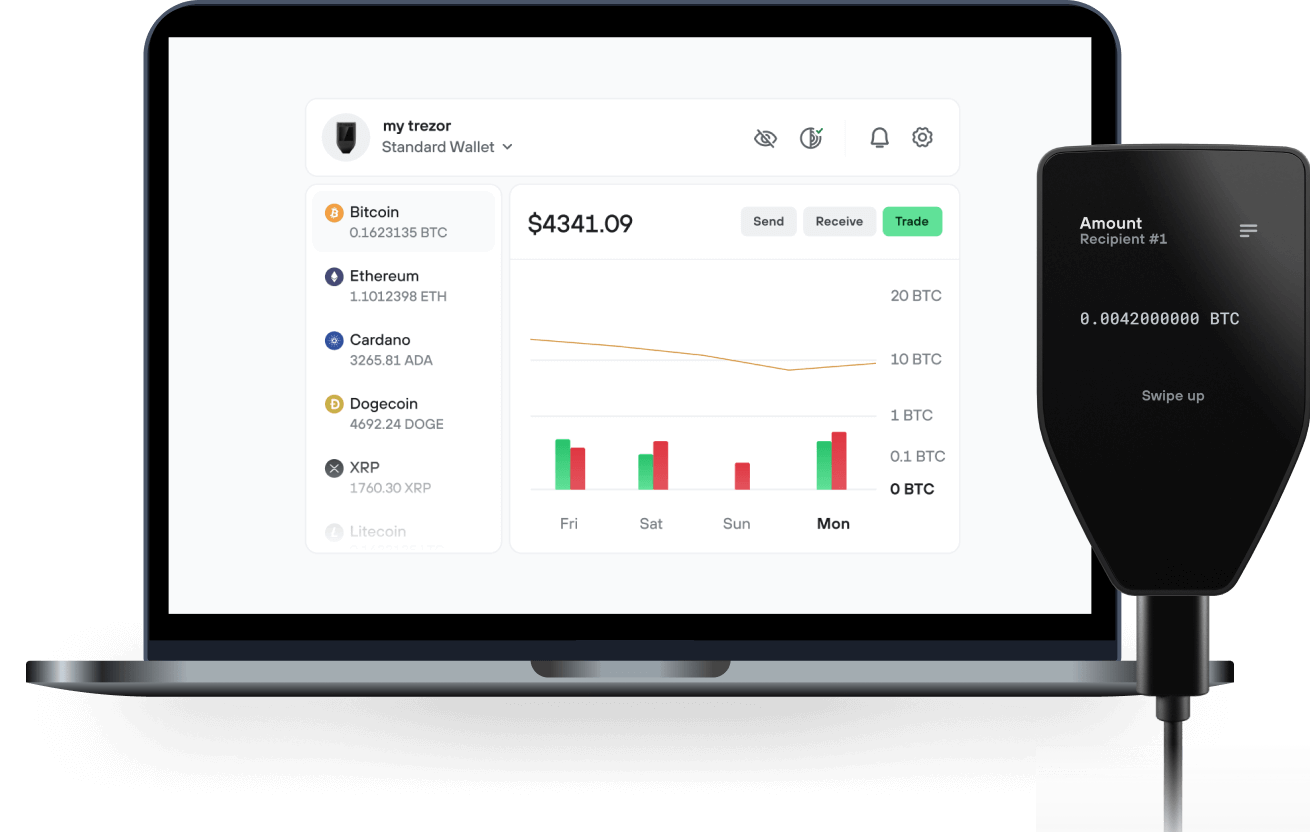
Sende & empfange deinen General Impressions mit der Trezor Suite App

Sende & empfange
Trezor Hardware-Wallet, die General Impressions unterstützen
Synchronisiere Trezor mit Wallet-Apps
Verwalte deine General Impressions mit deiner Trezor Hardware-Wallet, die mit mehreren Wallet-Apps synchronisiert ist.
Trezor Suite
Backpack
NuFi
Unterstütztes General Impressions Netzwerk
Warum eine Hardware-Wallet?
Gehe offline mit Trezor
- Du besitzt 100 % deiner Coins
- Deine Wallet ist offline zu 100 % sicher
- Deine Daten sind zu 100 % anonym
- Deine Coins sind an keine Firma gebunden
Online-Börsen
- Wenn ein Umtausch fehlschlägt, verlierst du deine Coins
- Börsen sind Ziele von Hackern
- Deine persönlichen Daten könnten offengelegt werden
- Du besitzt deine Coins nicht wirklich
Wie man GEN auf Trezor
Verbinde deinen Trezor
Öffne eine Drittanbieter-Wallet-App
Verwalte dein Vermögen
Mache das Beste aus deinen GEN
Trezor hält dein GEN sicher
 Geschützt durch Secure Element
Die beste Verteidigung gegen beides, online und offline Bedrohungen
 Deine Token, deine Kontrolle
Absolute Kontrolle über jede Transaktion mit Bestätigung auf dem Gerät
 Sicherheit beginnt mit Open-Source
Das transparente Wallet-Design macht deinen Trezor besser und sicherer
 Übersichtliches & einfaches Wallet-Backup
Stelle deinen Zugriff auf deine digitalen Assets wieder her mit einem neuen Backup-Standard
 Vertrauen vom ersten Tag an
Verpackungs- & Gerätesicherheitssiegel schützen die Integrität deines Trezors
General Impressions (GI) is a decentralized execution framework designed to support the emergence of Agentic AI—systems composed of autonomous software agents that can persist over time, coordinate with other agents, and adapt their behavior as they learn. Unlike traditional AI tools such as Manus, which executes discrete tasks without memory, or n8n, which automates workflows through static rule-based logic, GI provides a fully programmable runtime for long-lived, composable, and self-evolving agents. It does this through Glint, an open-source engine written in Rust, where agents are not stateless scripts but autonomous processes capable of maintaining state onchain, coordinating with other agents via native protocols, and dynamically updating their logic mid-execution. This enables a new kind of software behavior: not one-off responses, but ongoing loops of perception, memory, reasoning, and action—functionally similar to operating systems for agents.
Rust plays a central role in GI’s design. The language’s memory safety guarantees, concurrency model, and strict lifecycle control provide the stability and performance necessary for running agents over long time horizons. GI’s architecture embraces modularity at its core: agent logic is structured as a graph, where nodes represent functional modules and edges encode control and data flows. These modules are designed to be reused and recombined, allowing developers to build complex systems from simple, interoperable components. This makes GI fundamentally different from orchestration frameworks like LangChain or AutoGen, which focus on chaining prompts or managing tools, but lack persistence, runtime coordination, or any notion of lifecycle-aware agents.
What distinguishes GI is its ability to solve the “agentic trilemma”—the challenge of building agents that are at once flexible, general-purpose, and reusable. In legacy systems, agents either reset between runs (as with Manus), or rely on external, human-managed logic (as with n8n). In GI, agents can learn and change, coordinate natively, and persist their knowledge across context switches. These capabilities are not theoretical; GI has validated them in production through its Telegram Swarm, a network of agents operating across over 330,000 Telegram groups. These agents continuously scan messages, classify sentiment, track influencer dynamics, and autonomously take actions such as posting or triggering downstream systems—demonstrating the scalability and effectiveness of GI’s runtime.
More broadly, GI addresses a critical missing layer in the AI and crypto ecosystem. While many current projects focus on agent frontends, tooling layers, or token marketplaces, GI focuses on execution—the substrate on which all agent behavior runs. Just as Ethereum became the default environment for decentralized applications by solving composable, trustless execution for contracts, GI aspires to be the default runtime for autonomous agents. It is designed for a world in which software agents will increasingly operate without constant human supervision—researching, trading, moderating, governing, and negotiating in dynamic environments. In that world, the ability to persist, coordinate, and evolve will no longer be optional; it will be foundational. GI is building the infrastructure for that world.