Veuillez noter : nos articles de blog ne sont actuellement disponibles qu’en anglais.
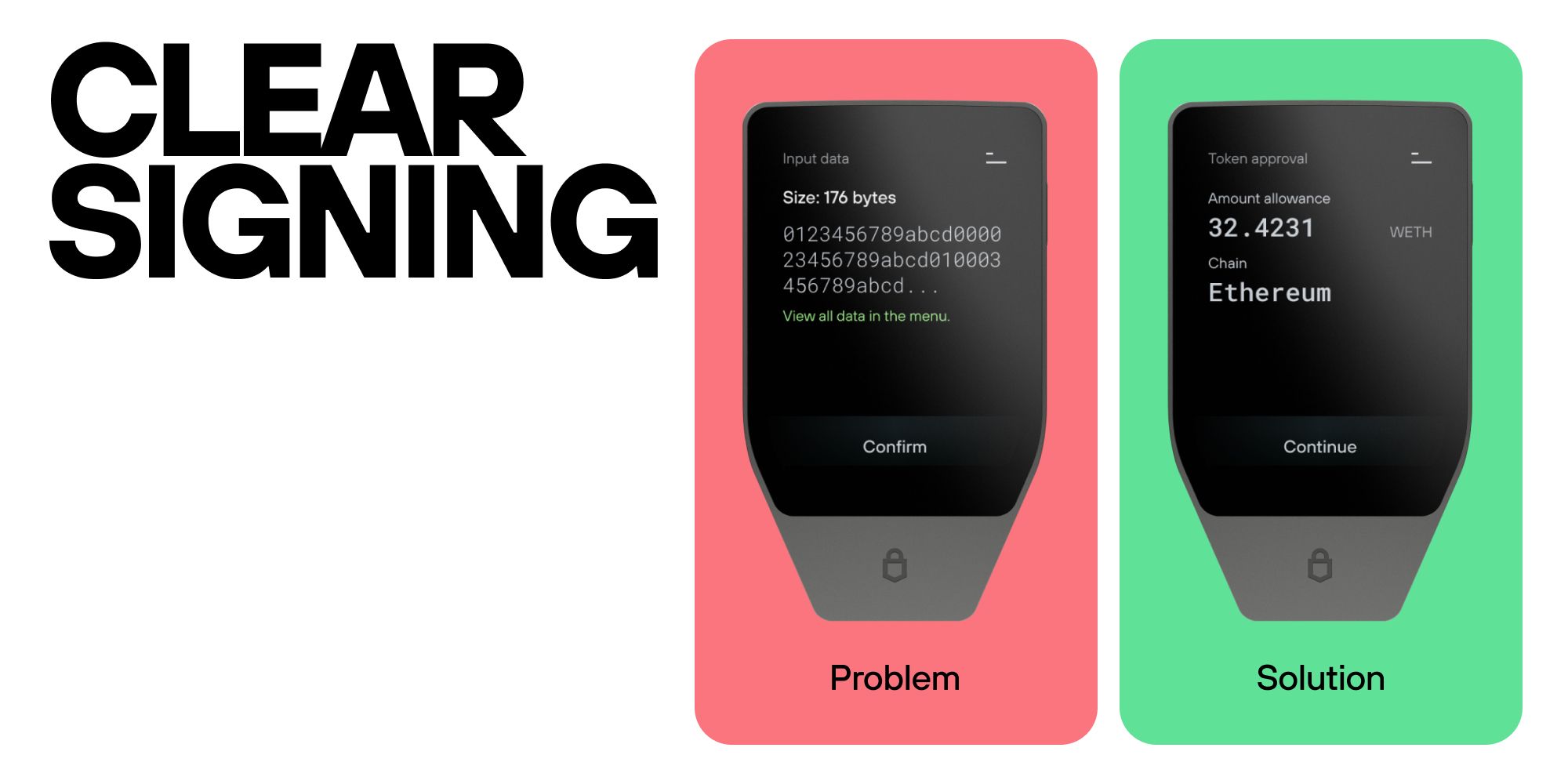
Clear Signing comes to Trezor (our flagship security feature of 2026)

Trezor Clear Signing removes the guesswork from interacting with smart contracts and dApps. Instead of approving unreadable hashes or raw transaction data, your Trezor decodes supported transactions and displays the real action, tokens, amounts, and addresses in plain language on your Trezor’s trusted screen. Built on an open-source stack, Clear Signing works across supported Ethereum and EVM-compatible networks through Trezor Suite, WalletConnect, and Trezor Connect, with no additional software or settings required.
An unaffordable cost of using DeFi…
Hardware wallets 101:
- Your wallet protects your private keys
- You sign transactions offline securely
- You verify transactions on a trusted screen
But… what if you’re using a decentralized application (dApp) and the transaction you’re signing looks like this:
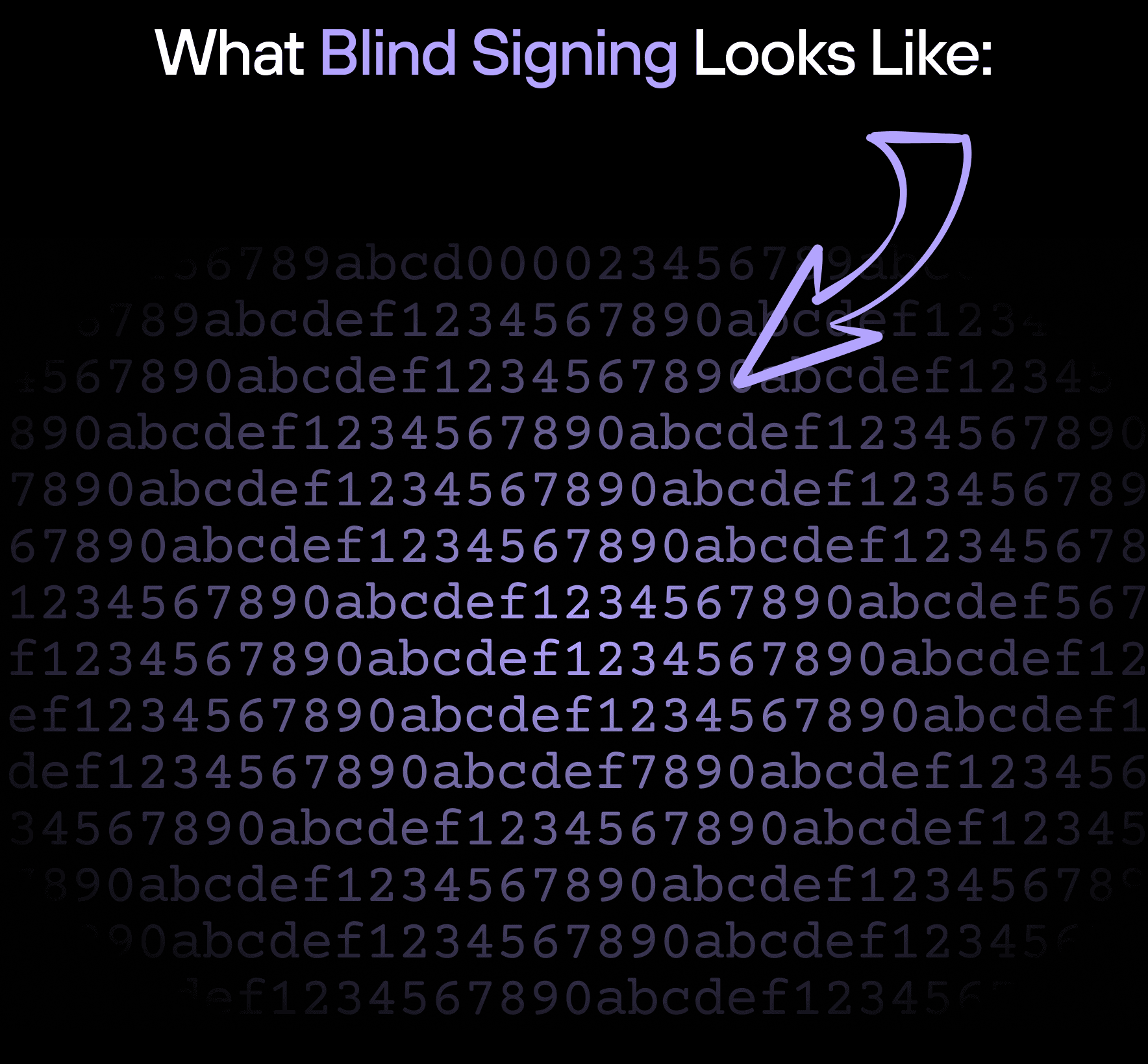
How are you supposed to know what you’re actually signing if it’s a string of hexadecimal data? How can you verify the transaction?
This is called blind signing, and it’s resulted in a lot of funds being lost to users who unknowingly signed malicious transactions.
Here’s what was happening before Clear Signing:
- You see a readable description of your transaction on your computer screen, like “swap 2,000 USDC for ETH”.
- Calldata that encodes the function being called and its parameters is then sent to your hardware wallet and is presented as a hash or “Data Preset”.
- You sign the transaction, essentially trusting that the human-readable description on the computer screen is what’s reflected on the hardware wallet screen (should be the opposite).
- If your computer was compromised, but you could not confirm this on your hardware wallet because you were only shown the hash, you might mistakenly sign away your assets.
Many wallet drainers and compromised frontends exploit this gap.
What Clear Signing is and how it fixes blind signing
Trezor Clear Signing translates complex transactions into plain language, so you never approve something you don't understand.
Now, instead of showing this:
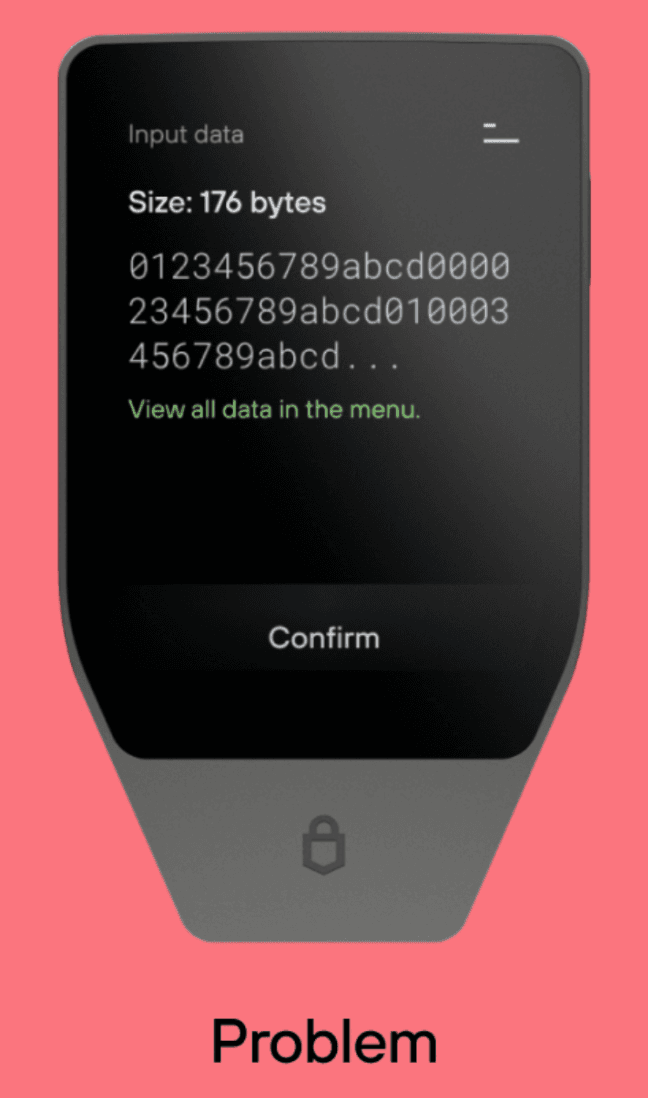
You see this:
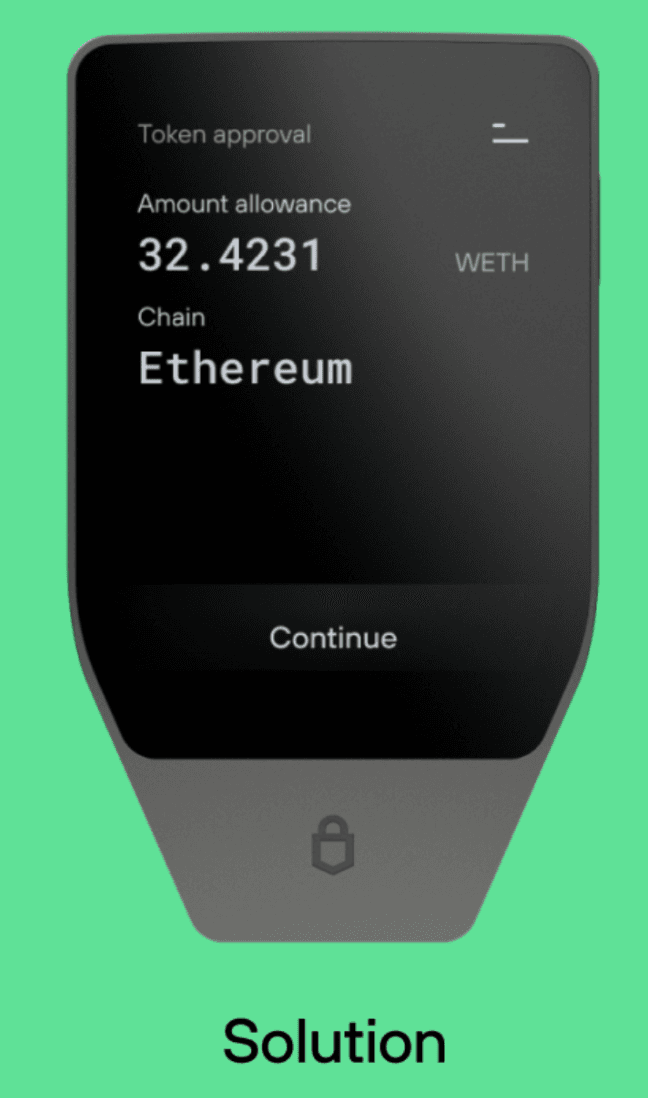
Clear Signing ensures that your Trezor Hardware wallet remains as the final source of truth, by translating the complex smart contract data (key details, including actions, tokens, amounts, and addresses) into human-readable language, so you’re not doing this:
Regardless of what your computer screen claims, you now know with certainty that your hardware wallet is showing what you’re actually signing.
No trust, guesswork, or a leap of faith every time you sign, helping reduce the risk of approving a harmful transaction.
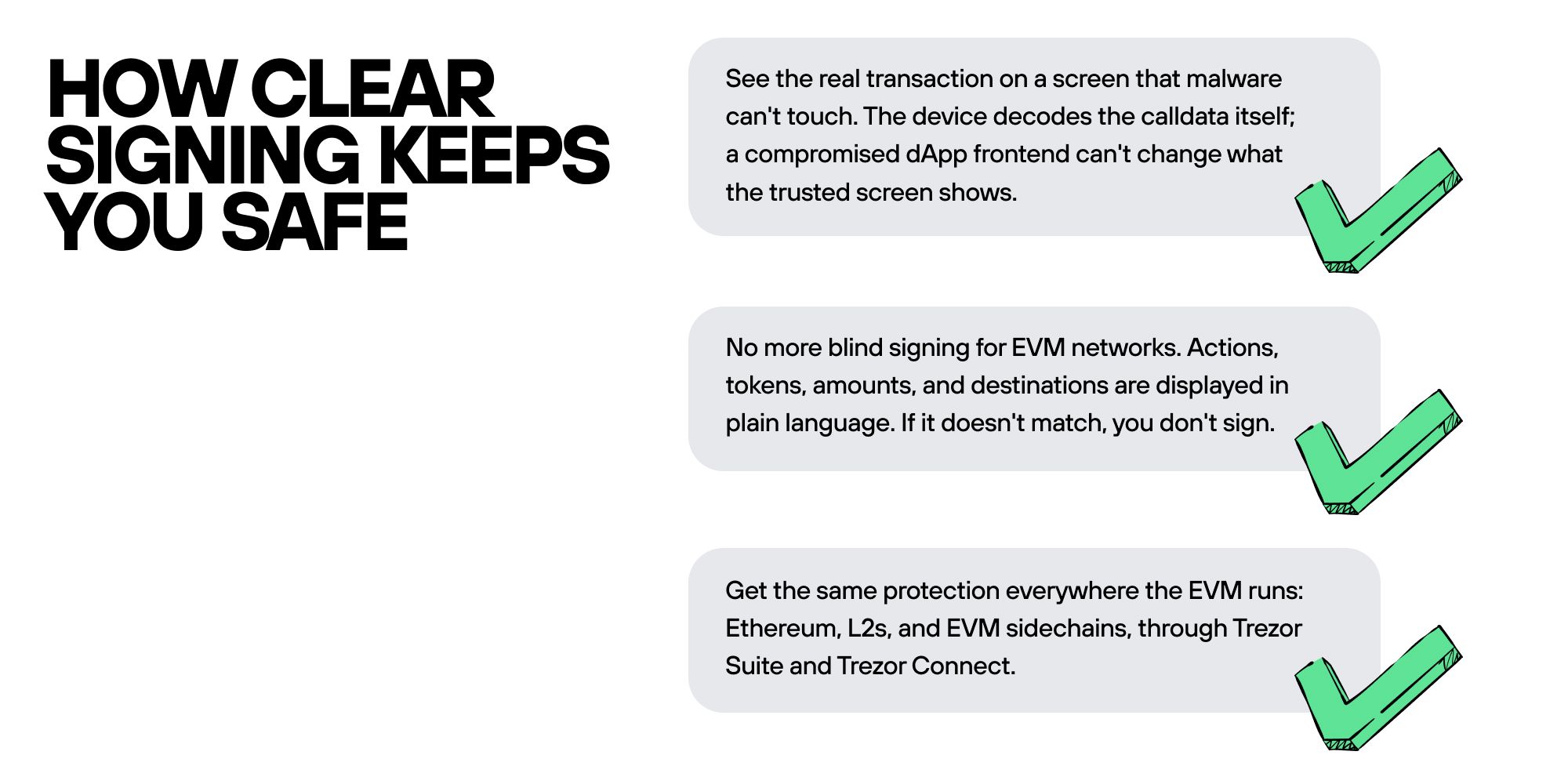
Clear Signing works with supported smart contracts in the ERC-7730 registry. If a contract isn't supported yet, your Trezor will fall back to the standard blind-signing warning.
No setup required
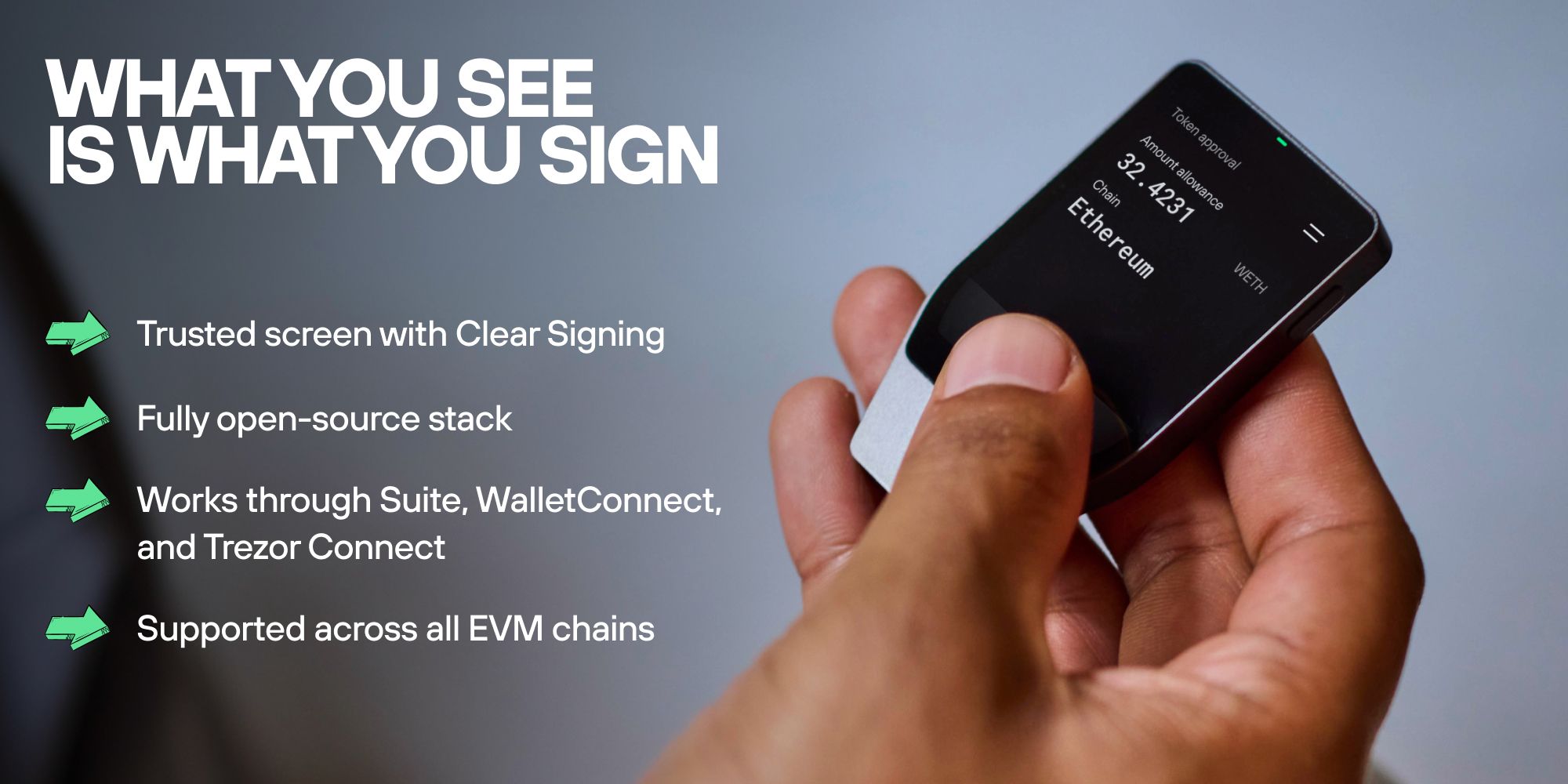
Clear Signing works automatically with Trezor Suite, WalletConnect, and Trezor Connect. Other than updating your Trezor firmware, there’s nothing new to install or any settings to turn on. Your usual workflow stays exactly the same, except the verification process is now fast and reliable.
Backed by a fully open-source stack
Trezor’s firmware is fully open-source, and we’ve designed the Clear Signing stack firmware and decoding logic to be the same. The ERC-7730 standard is open and publicly available too, so anyone can verify how it works (community audits are encouraged). You don’t need to blindly trust. As more apps adopt the standard, coverage will grow.
Your questions, answered (FAQs)
Does Clear Signing work with every smart contract?
No. Clear Signing coverage is based on the ERC-7730 registry (Ethereum, Layer 2 networks, and other EVM-compatible chains). A smart contract needs a supported ERC-7730 descriptor for Trezor to decode and display it using Clear Signing.
At launch, this covers major protocols including 1inch, Aave, Lido, Tether, LiFi, Hyperliquid, and others. We are working to add support for more networks.
If a contract is not supported, the transaction falls back to the standard blind-signing experience and warning.
Do I need to enable Clear Signing?
No. There is no separate setting to enable. For supported transactions, Clear Signing works automatically through Trezor Suite, WalletConnect, and Trezor Connect.
Is Trezor Clear Signing open-source?
Yes. Trezor’s Clear Signing stack, including the firmware, ERC-7730 parsing, transaction decoding logic, and display pipeline, is open-source and available for inspection and community auditing.
What is ERC-7730?
ERC-7730 is an open standard that gives wallets a consistent way to turn complex smart contract data into clear, readable transaction details. Trezor uses it to show supported actions, amounts, tokens, and destinations in plain language on your device.
Which Trezor models support Clear Signing?
Trezor models running standard firmware that support Ethereum and EVM chains include Trezor Safe 7, Safe 5, Safe 3, and Model T. Clear Signing is not available on the Trezor Model One.