Billetera NodeAI segura y protegida
Toma el control de tus NodeAI activos con total confianza en el ecosistema de Trezor.
- Protegido por tu billetera física
- Usa con billeteras digitales compatibles
- Con la confianza de más de 2 millones de clientes
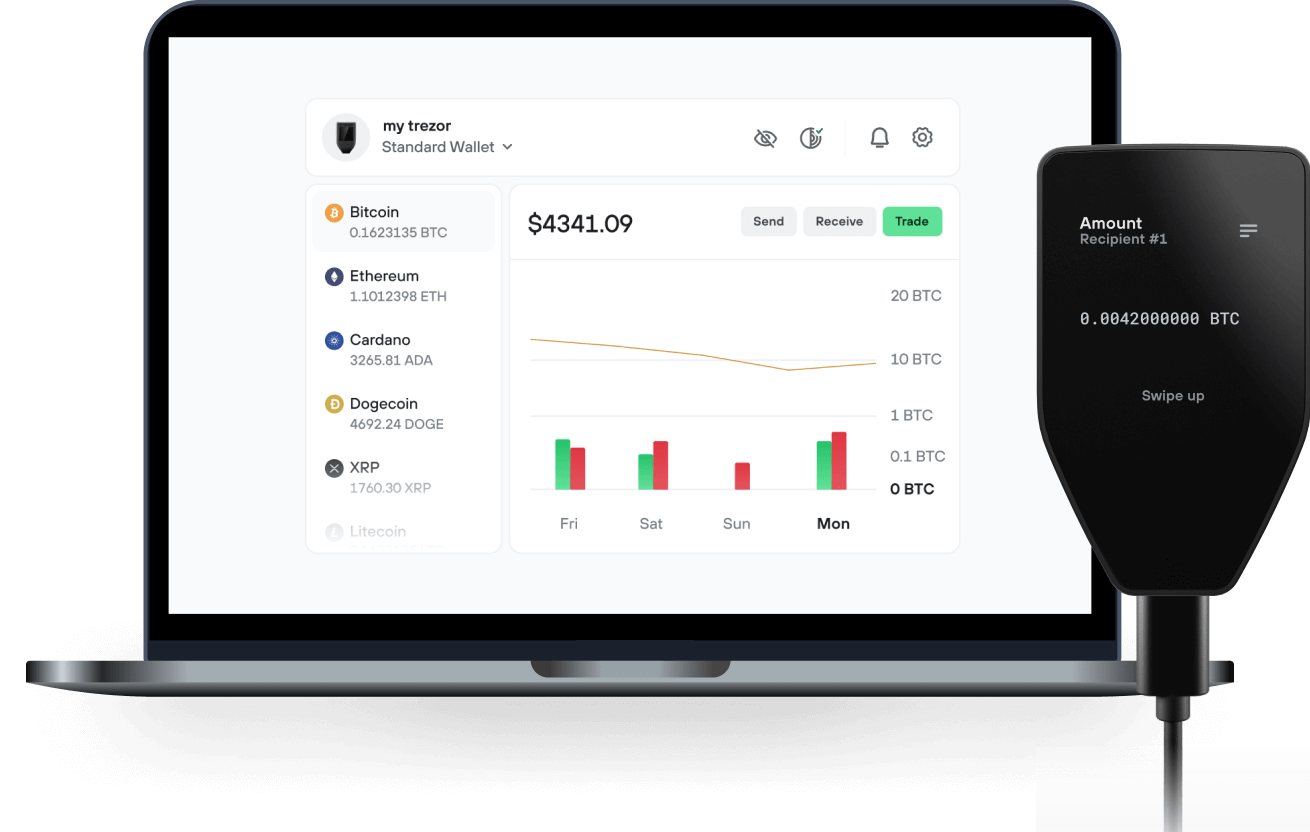
Envía y recibe tu NodeAI con la app Trezor Suite

Enviar y recibir
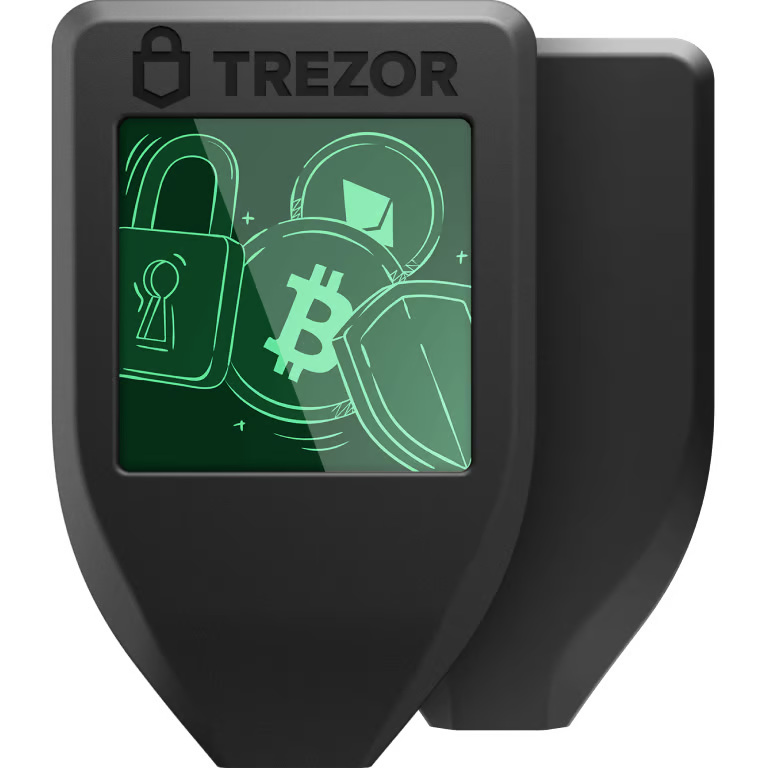
Billeteras físicas Trezor compatibles con NodeAI

Sincroniza tu Trezor con apps de billeteras
Gestiona tus NodeAI con tu billetera física Trezor sincronizada con apps de billeteras.
Trezor Suite
MetaMask
Rabby
Red NodeAI Compatible
- BNB Smart Chain
¿Por qué una billetera física?
Desconéctate con Trezor
- Tus monedas son 100% tuyas
- Tu billetera está 100% segura offline
- Tus datos son 100% anónimos
- Tus monedas no están atadas a una compañía
Exchanges en línea
- Si un exchange falla, pierdes tus monedas
- Los exchanges son blanco de los hackers
- Tu información personal puede ser expuesta
- Tus monedas no son realmente tuyas
¿Cómo usar NAIT en Trezor?
Conecta tu Trezor
Abre una app de billetera de terceros
Gestiona tus activos
Aprovecha al máximo tus NAIT
Trezor mantiene tus NAIT seguros
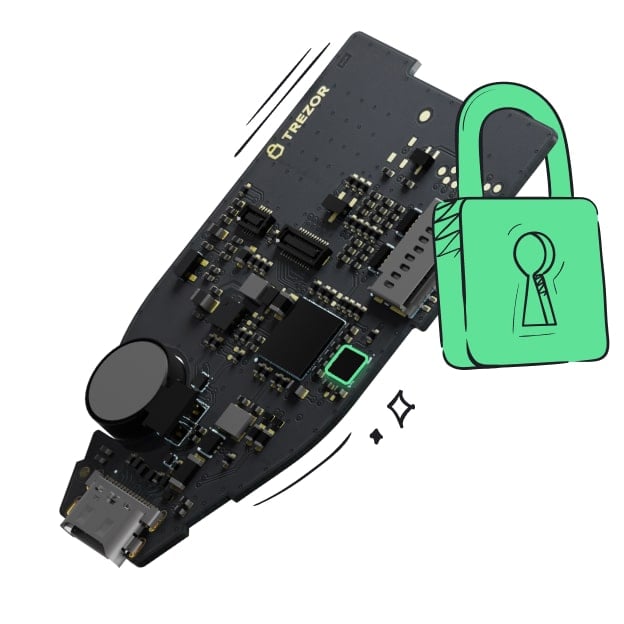 Protegido por Elemento Seguro
La mejor defensa contra amenazas tanto online como offline
 Tus tokens, bajo tu control
Control absoluto de cada transacción con confirmación directa en el dispositivo
 La seguridad empieza por código abierto
Un diseño de billetera de forma transparente hace que tu Trezor sea más seguro y confiable
 Copia de seguridad de billetera clara y sencilla
Recupera el acceso a tus activos digitales con nuevo estándar de copia de seguridad
 Confianza desde el primer día
El embalaje y los sellos de seguridad del dispositivo protegen la integridad de tu Trezor
The production of machine intelligence has come to rely almost entirely on a system of benchmarking, where machine learning models are trained to perform well on narrowly defined supervised problems. While this system works well for pushing the performance on these specific problems, the mechanism is weak in situations where the introduction of markets would enable it to excel. For example, intelligence is increasingly becoming untethered from specific objectives and becoming a commodity that is expensively mined from data, monetarily valuable, transferable, and generally useful. Measuring its production with supervised objectives does not directly reward the commodity itself and causes the field to converge toward narrow specialists. Moreover, these objectives (often measured in uni-dimensional metrics like accuracy) do not have the resolution to reward niche or legacy systems, thus what is not currently state of the art is lost. Ultimately, the proliferation of diverse intelligence systems is limited by the need to train large monolithic models to succeed in a winner-take-all competition. Standalone engineers cannot directly monetize their work and what results is centralization where a small set of large corporations control access to the best artificial intelligence.
A new commodity needs a new type of market. This paper suggests a framework in which machine intelligence is measured by other intelligence systems. Models are ranked for informational production regardless of the subjective task or dataset used to train them. By changing the basis against which machine intelligence is measured, the market can reward intelligence that is applicable to a much larger set of objectives, legacy systems can be monetized for their unique value, and smaller diverse systems can find niches within a much higher resolution reward landscape. The solution is a network of computers that share representations continuously and asynchronously, peer-to-peer (P2P) across the internet. The constructed market uses a digital ledger to record ranks and to provide incentives to peers in a decentralized manner. The chain measures trust, making it difficult for peers to attain rewards without providing value to the majority. Researchers can directly monetize machine intelligence work and consumers can directly purchase it.